


2025 Ford Explorer vs. 2025 Hyundai PALISADE: Clash of Titans
If you’re looking for a new family hauler, the 2025 Ford Explorer and Hyundai PALISADE are great choices in the three-row SUV market. Our team at Jim Bass Ford has looked at each of these vehicles in detail to help you decide which one might be right for your driveway.
Exterior Design and Dimensions
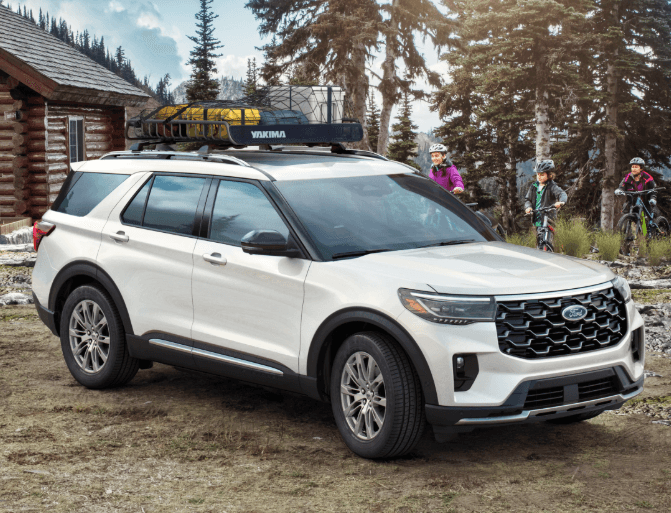
Park these SUVs side by side and you’ll notice they have distinct personalities. The Explorer has a sportier vibe with a boxier grille, clean headlight design, and LED taillights that stretch inward to create a look that’s distinctly Ford. The PALISADE takes a different path with a more upscale approach that includes an LED lighting signature and a bold grille that suggests greater luxury within.
The Explorer is slightly taller at 69.6 inches, versus the PALISADE’s 68.9 inches, and it stretches longer at 198.8 inches, compared to 196.7 inches for the PALISADE. The Ford’s wheelbase is also longer; it measures 119.1 inches, while the Hyundai’s measures 114.2 inches.
Interior Comfort and Quality
The PALISADE’s cabin feels like something from a luxury brand, with options such as quilted leather seats and air-conditioned second and third rows. It seats up to eight passengers, making it perfect if you have a large family or regularly run carpool duty.
The 2025 refresh of the Ford Explorer has improved materials and tighter build quality throughout. It seats seven rather than eight, and while it’s not as plush as the Hyundai, it’s still a comfy place for road trips. If you care more about function than frills, the Explorer delivers what matters.
Cargo Space and Versatility
When it comes to hauling, the Explorer comes out slightly on top. You get 18.2 cubic feet behind the third row (versus the PALISADE’s 18 cubic feet), 47.9 cubic feet with the third row down (versus the PALISADE’s 45.8 cubic feet), and 87.8 cubic feet max (versus the PALISADE’s 86.4 cubic feet). Not huge differences, but every bit counts when you’re loading up for vacation. Both SUVs can tow up to 5,000 pounds when properly equipped.
Technology and Infotainment
The Explorer has a massive 13.2-inch touch screen running Google-based software. It’s your command center for everything from maps to music, with standard Android Auto, Apple CarPlay, satellite radio, and a Wi-Fi hot spot. The screen responds quickly to taps and swipes, making it less distracting when you’re on the move. The PALISADE has a slightly smaller 12.3-inch display, but its interface is intuitive and comes with all the same standard technology as the Explorer.
Performance and Driving Experience
Engine options are arguably where these vehicles differ the most. The Explorer has a 2.3L turbo four-cylinder that produces 300 horsepower and 310 lb-ft of torque or a 3.0L twin-turbo V-6 with 400 horsepower and 415 lb-ft of torque. Both engines pair with a 10-speed automatic transmission. The PALISADE only has one engine: a 3.8L V-6 that produces 291 horsepower and 262 lb-ft of torque, paired to an eight-speed automatic. The rear-wheel-drive setup on the Explorer lets it tackle corners with unusual agility for a family hauler, while the PALISADE’s suspension is tuned for quiet comfort rather than corner carving.
Fuel Economy and Efficiency
The rear-wheel-drive Explorer also has a slight advantage at the pump, achieving 20 mpg in the city and 29 mpg on the highway, which is decent for a vehicle of its size and could make a difference if you rack up lots of miles or want to stretch your fuel budget. The PALISADE will give you 19 mpg in the city and 26 mpg on the highway with front-wheel drive. The highway difference could well add up on long trips, though real-world results always vary based on your driving style and local conditions.
Safety Features and Ratings
As of late May 2025, the 2025 Explorer hasn’t received National Highway Traffic Safety Administration (NHTSA) ratings, but the Insurance Institute of Highway Safety (IIHS) rates it Good in all major crash tests (with no Top Safety Pick award). By contrast, the 2025 Palisade already carries over its five-star NHTSA score and holds a 2025 Top Safety Pick from IIHS.
Hyundai loaded the PALISADE with safety tech, and you get cool features that other SUVs charge extra for, such as Junction Turning Detection that helps avoid cross-traffic accidents and Evasive Steering Assist that supports emergency maneuvers. The Explorer doesn’t skimp on protection either, with blind-spot warnings, lane-keeping assistance, and collision alerts standard on every model. Ford has a solid track record, and both SUVs put your family’s safety first, but you may find that the PALISADE includes more advanced systems without making you pay for optional packages.
Warranty and Maintenance
Hyundai is known for its warranty coverage, and the PALISADE is no exception. It comes with 10-year or 100,000-mile powertrain coverage, which is double the Explorer’s five-year or 60,000-mile offering. If you plan to keep your SUV long-term, this difference could potentially save you money down the road. Despite that, the Explorer has strong reliability scores from J.D. Power, which gave it 87 out of 100 for predicted reliability, suggesting fewer problems might pop up in the first place. Both brands let you buy extra warranty coverage if you want more protection, but Hyundai’s standard package is tough to beat.
Pricing and Value Proposition
The Explorer starts at $39,785 for the Active trim and reaches $54,240 for the ST, while the PALISADE runs from $37,200 for the SE to $54,500 for the Calligraphy Night Edition. Value goes beyond the sticker price. According to U.S. News & World Report, the PALISADE sits second in the midsize-SUV class with a 9.4/10 score, while the Explorer lands at 14th with an 8.7/10 score.
Whether you prioritize driver engagement or plush comfort will ultimately decide which one delivers better value for you. If you want to trade in a vehicle, or need to apply for financing for a 2025 Ford Explorer, we can do all that and more at Jim Bass Ford.
Which Is Better for You?
If you love driving, want maximum power and efficiency, and need to tow regularly, the Explorer will probably make more sense. Its rear-wheel-drive platform and turbo engines create a more engaging experience for you as a driver, while still handling family duties. If you put comfort, cabin quality, and safety tech at the top of your list, the PALISADE may fit the bill. Its interior feels a class above, and it has certain features that are missing from the Explorer.
Test-Drive the 2025 Ford Explorer at Jim Bass Ford
Whether you’re looking at new or used vehicles, the best way to work out what’s right for you is to get behind the wheel and take one out for a test-drive. At Jim Bass Ford in San Angelo, Texas, we have a full complement of new Explorers waiting for you to come and put them through their paces. Contact us and see why the Explorer is the perfect SUV to transform your daily drive.

0 comment(s) so far on 2025 Ford Explorer vs. 2025 Hyundai PALISADE: Clash of Titans